3D food printing will not replace traditional production lines, but it can become a process module for highly complex niche markets: senior nutrition, dysphagia, plant-based foods, functional snacks, and gourmet foods, where shape, texture, and composition become valuable, controllable industrial variables.
12:30 p.m. Lunchtime. In a home kitchen of a future that may not be so far off, software prepares personalized recipes based on nutritional needs, sensory preferences, desired texture, and portion size. A food cartridge deposits layers of dough, gel, or plant-based proteins; a few minutes later, a custom-designed food appears on the plate. This is the most evocative image of 3D food printing: science fiction, perhaps, but not entirely out of step with current research trends.
While this scenario may still seem distant in a domestic setting, the food industry and researchers are already working to implement the technology in more concrete applications—not as an alternative to traditional high-throughput production lines, but as a potential process module for specialized production. This is where 3D food printing can find its niche: where shape, texture, portion control, and nutritional customization matter more than speed—from senior nutrition to dysphagia, from structured plant-based foods to functional snacks and gourmet applications.
Where 3D food printing is already feasible
Research is underway, the food industry is taking its first steps, and 3D food printing—the construction of food through the controlled, layer-by-layer deposition of edible matrices designed from a digital model—is beginning to move beyond the realm of technological demonstration to carve out its own place in production. Not everywhere, not for every food product, and not with the same level of maturity. The point is not to envision production lines capable of replacing conventional processes, but to understand in which areas controlled deposition can generate real value.
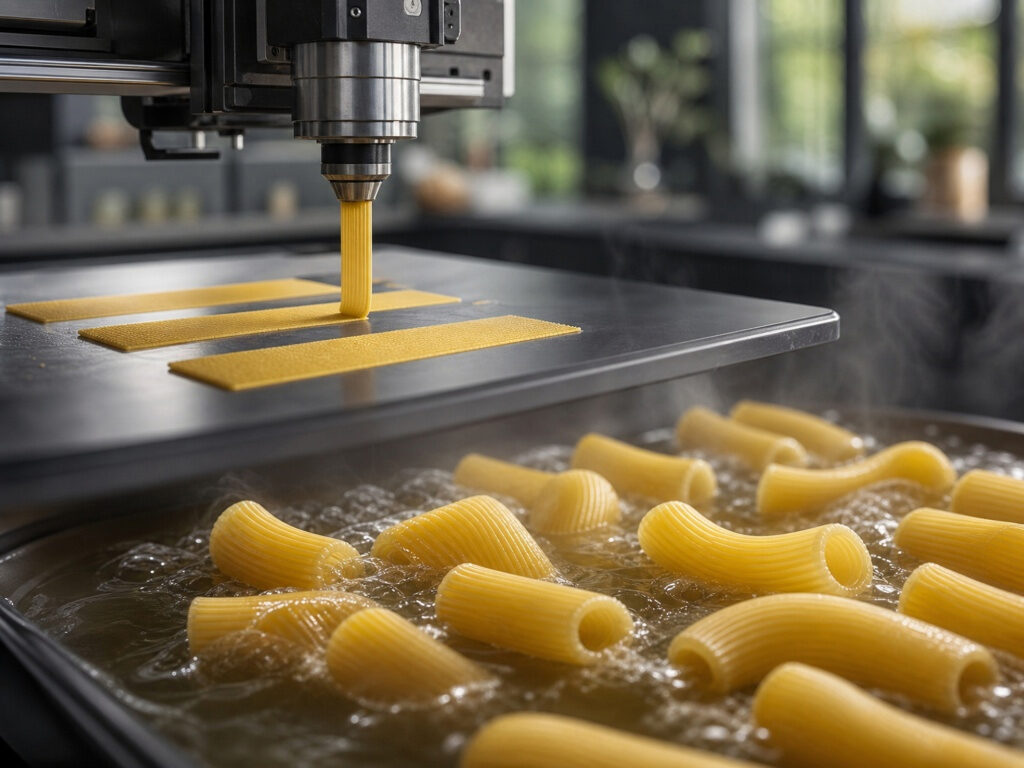
The most convincing answer comes from products where shape, texture, composition, and portion size are not merely commercial variations, but integral to their function. This is the case with texture-modified foods for the elderly and patients with dysphagia, where purees and soft matrices can be restructured into more recognizable forms and enriched in a controlled manner. The same principle, with different objectives, applies to high-end pasta and chocolate, functional snacks, and structured plant-based products, where gels, emulsions, and protein-based mixtures allow for manipulation of internal geometries, ingredient distribution, and sensory perception. These applications differ in maturity and scale but are united by the same logic: not to produce faster, but to produce in a more targeted manner [Derossi A et al. npj Sci Food 2024; IUFoST Sci Inf Bull 2021; Ma Y et al. Curr Opin Food Sci 2019].
From the printer to the food machine
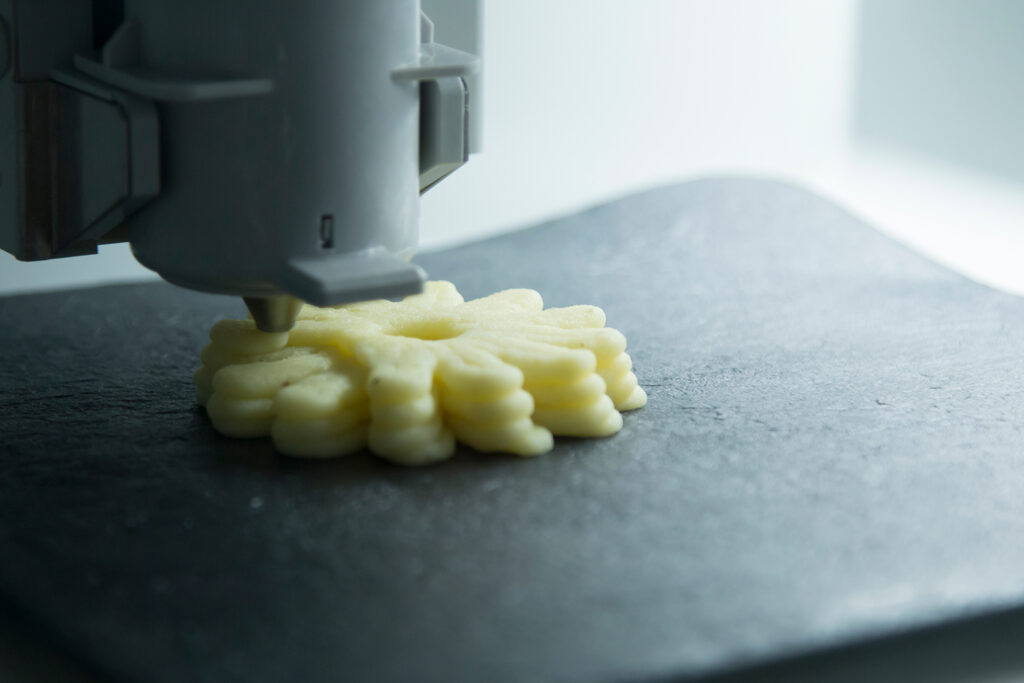
For this process to become industrialized, however, the printer must cease to be viewed as a laboratory device and instead be regarded as a food-grade machine. At the heart of the process, in most of today’s most realistic applications, is extrusion: a deposition system capable of processing pastes, purees, doughs, gels, chocolate, cheeses, emulsions, and protein matrices with widely varying viscosities and behaviors [Xiao S et al. Foods 2025; Paolillo M. PhD Thesis, University of Foggia, 2022]. Alternatives do exist—inkjet, binder jetting, powder-based systems, or hybrid solutions—but they remain more limited, often tied to specific materials or functions [Paolillo M. PhD Thesis, University of Foggia, 2022; Zhu W et al. Foods 2023]. Extrusion, on the other hand, taps into the most promising aspect of 3D food printing: transforming a semi-solid food matrix into a controlled three-dimensional structure.
This gives rise to the distinction between syringe-based systems, suitable for small batches and more viscous materials, pneumatic systems, which are more sensitive to pressure regulation, and screw-based solutions, which operate on a continuous-feed principle because they allow material to be fed during deposition—though they are not without challenges when the matrix exhibits high viscosity or mechanical resistance, potentially leading to control issues, thermomechanical stress, and localized overheating [Paolillo M. PhD Thesis, University of Foggia, 2022]. The industrial challenge lies precisely here: it is not enough to deposit food in a new form; it is necessary to control flow rate, temperature, pressure, nozzle geometry, cleanability, and repeatability as process variables [Xiao S et al. Foods 2025; Derossi A et al. npj Sci Food 2024].
Food ink: when the recipe becomes the process material
It is in food ink that the machine encounters its true critical material. In 3D food printing, a recipe is no longer merely a sensory or nutritional formulation; it becomes a process material, required to behave predictably inside the nozzle, during deposition, and after layer formation. A dough, purée, or gel must flow when subjected to stress, quickly regain its structure once deposited, and support the weight of subsequent layers without collapsing. It is within this rheological window that much of the printability is determined: viscosity, shear-thinning behavior, yield stress, thixotropy, and post-extrusion stability are not mere laboratory details, but parameters that determine geometric accuracy, process continuity, and the quality of the finished product.
The literature indicates, as a guideline, a yield stress range of approximately 500–1,500 Pa as a useful range for combining extrudability and structural integrity, although this depends heavily on the matrix and machine parameters [Derossi A et al. npj Sci Food 2024; Paolillo M. PhD Thesis, University of Foggia 2022]. The complexity increases because food matrices are biologically variable and sensitive to temperature, resting time, hydration, particle size, and interactions between ingredients. For this reason, hydrocolloids, protein gels, emulsions, oleogels, and multi-material systems serve not only to “make a food printable,” but also to construct a raw material designed to be dispensed, deposited, stabilized, and consumed with repeatable characteristics [Ma Y et al. Curr Opin Food Sci 2019; Yang M et al. Gels 2026].
Senior Nutrition and Dysphagia: The Most Established Application
Among the most well-established applications today, senior nutrition and foods for dysphagia likely represent the area where 3D food printing most clearly demonstrates its practical value. The underlying problem is well known: in texture-modified diets, safe swallowing is often achieved at the expense of a significant loss of recognizability, palatability, and nutritional density. Purees, blended foods, and homogenized preparations meet a functional need, but they can reduce the enjoyment of a meal and contribute to lower energy and protein intake in frail individuals [Lorenz T et al. Foods 2022; Shao J et al. Foods 2025].
In this context, 3D food printing adds value not because it “shapes” food in an aesthetic sense, but because it allows for the reconstruction of soft, safe matrices in controlled portions that are more recognizable and potentially enriched with protein, vitamins, or other nutrients. The decisive step is anchoring the process to objective texture criteria: printed foods for patients with dysphagia can be evaluated based on IDDSI levels and practical tests—such as fork pressure tests—to assess cohesion, softness, and suitability for swallowing [Lorenz T et al. Foods 2022; Shao J et al. Foods 2025; Yang M et al. Gels 2026].
The European PERFORMANCE project has clearly demonstrated this direction: bringing pureed foods back to forms closer to the original food, integrating nutritional customization, meal management software, and production methods better suited to nursing homes and care- d food services [CORDIS, 3D printing to the rescue of gastronomy for frail seniors 2023]. This application still needs to be scaled up, but it is industrially promising because it addresses clinical needs while ensuring texture standardization, portion control, and process repeatability.
Structured plant-based foods: building fiber, fat, and texture
A second area—less developed but closely watched by the industry—is that of structured plant-based foods. Here, 3D food printing ventures into territory distinct from clinical nutrition: it must not only make food more customizable but also help shape the product’s textural experience. In plant-based meat substitutes, one of the main challenges remains the reproduction of fiber, juiciness, fat distribution, and chew resistance—that is, the internal architecture that, in animal-based products, arises from a complex biological structure.
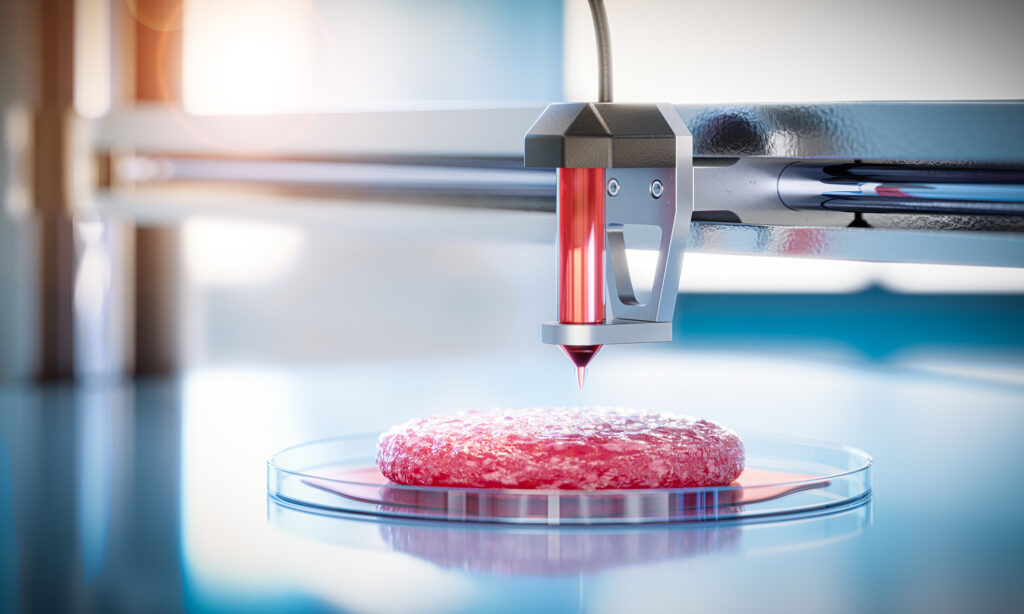
The multi-material deposition of protein batters, gels, emulsions, and oleogels can offer a way to spatially organize components with different behaviors: the protein phases influence texture and chew resistance, while oleogels and emulsions can help simulate the lipid component, juiciness, and sensory release during consumption [Xiao S et al. Foods 2025; Derossi A et al. npj Sci Food 2024; Ma Y et al. Curr Opin Food Sci 2019]. This is a field in which startups and applied research have already produced interesting examples, but the gap to industrial-scale production remains significant: costs, deposition speed, formulation stability, and integration with cooking or post-processing are still unresolved issues [Eswaran H et al. Ann 3D Print Med 2023; Ma Y et al. Curr Opin Food Sci 2019]. The value of 3D food printing, in this case, lies not in imitating meat visually, but in using geometry to influence structure, texture, and sensory perception.
Functional Snacks, Gourmet Foods, and Nutritional Customization
Among gourmet applications, functional snacks, and personalized products, 3D food printing reveals another potential area of development: not so much to replace existing production methods, but to add design freedom where shape and composition can become tools for differentiation. In chocolate, pasta, and certain high-end preparations, the advantage is primarily geometric and sensory: creating complex shapes, cavities, textures, and ingredient distributions that are difficult to achieve with traditional technologies— —while working with small batches and high-value products [IUFoST Sci Inf Bull 2021; Derossi A et al. npj Sci Food 2024].
In functional snacks, however, the focus shifts to controlling the internal structure and formulation: density, porosity, fill, the release of bioactive ingredients, caloric modulation, and targeted enrichment can all be designed together—at least in theory—within the same digital process [Ma Y et al. Curr Opin Food Sci 2019; Xie Y et al. Foods 2023]. Internal geometry is not just about appearance: the fill percentage, pattern, and spatial distribution of ingredients can influence texture, the perception of satiety, and the rate of release during chewing. This is where personalized nutrition moves beyond a mere slogan and becomes a practical process: not a different recipe for every consumer, but the ability to produce controlled variations tailored to user groups, specific needs, or consumption contexts. Here, too, scale remains the deciding factor: the value lies not in speed, but in the ability to transform formulation complexity and food design into repeatable, recognizable, and industrially manageable products.
The barrier to industrialization: productivity, hygiene, and shelf life
It is on this point that 3D food printing encounters its most severe limitation: transforming a technology capable of customization into one capable of mass production. Productivity remains the primary obstacle, because layer-by-layer deposition takes times that are difficult to compare with those of conventional molding, extrusion, or dosing; for this reason, the most viable application remains that of small batches, high-value production, and products where complexity compensates for the slower speed [Derossi A et al. npj Sci Food 2024; IUFoST Sci Inf Bull 2021].
But scale is not just a matter of pieces per hour. In a food processing plant, nozzles, cartridges, pistons, contact surfaces, and feed circuits must be designed with cleaning, sanitization, disassembly, stagnation prevention, and microbiological control in mind—especially when processing wet, nutrient-rich, and often temperature-sensitive matrices [Food Standards Agency Rapid Evid Assess 2021; Xiao S et al. Foods 2025].
The internal geometry of components, the presence of dead zones, surface roughness, and difficulty in inspection can become critical points for residues, contamination, and biofilm formation. Added to this are shelf life, post-printing stability, packaging, transportation, and texture retention until consumption: a “ ” printed food must not only come out of the machine in good condition but remain safe, recognizable, and functional throughout the entire supply chain. This is where the printer must truly become a food-grade machine: not an isolated device, but a controllable part of a complete process.
Regulation and safety: food printing cannot exist outside the HACCP framework
The same logic applies to food safety and regulation: 3D food printing does not operate in a “free zone” with respect to HACCP, but is subject to the same requirements for risk analysis, hazard control, and process validation that govern all food production. In fact, the combination of wet matrices, deposition times that are not always short, complex contact surfaces, and the possibility of customizing recipes can make identifying critical control points more complex.
It is not enough to know that the ingredients are edible; it is necessary to assess how they are prepared, loaded, extruded, heated or cooled (if applicable), stabilized, packaged, and stored. Assessments by the Food Standards Agency highlight precisely these issues: contamination from the operating environment, microbial growth during slow processing or at suboptimal temperatures, the use of unauthorized or hard-to-trace ingredients, risks of adulteration, and the need for regulatory oversight commensurate with technological advancements [Food Standards Agency Rapid Evid Assess 2021].
In the European context, this is compounded by the potential applicability of EU Regulation 2015/2283 on Novel Foods when the process uses ingredients, protein sources, byproducts, or formulations not associated with established food use. From an industrial perspective, therefore, the safety of food printing depends not only on the ink formulation or the precision of the machine, but on the ability to integrate traceability, design hygiene, parameter control, recipe validation, and variability management within a quality system already recognized by the food industry [Xiao S et al. Foods 2025; Derossi A et al. npj Sci Food 2024].
A Specialization of the Production Line, Not Its Replacement
The most realistic path, therefore, is not that of a technology intended to replace the food production line, but rather its potential specialization. 3D food printing can make sense where standardized production reaches its limits: when the product’s value depends on the ability to control shape, texture, composition, portion size, and nutritional function with a level of precision exceeding that required by conventional production.
To get there, however, the promise of customization must translate into measurable industrial requirements: machines designed for real food, software not passively derived from other sectors, reproducible food inks, hygienic design, quality control, post-processing, and packaging consistent with the expected shelf life [Derossi A et al. npj Sci Food 2024; Xiao S et al. Foods 2025]. It is in this area that 3D food printing will be able to move beyond the rhetoric of “food of the future.” Not as a general-purpose revolution, but as a highly complex niche technology, capable of complementing the production line when variability is not a defect to be reduced, but a feature to be designed.