 Development of a new pizza production process based on high-pressure proofing of the dough.
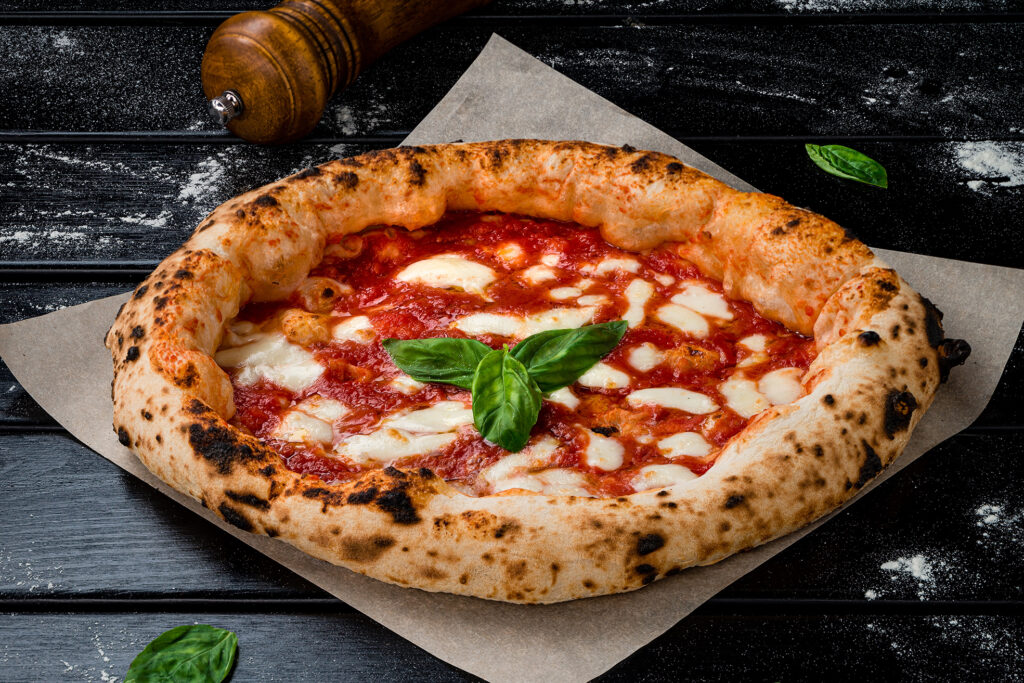
Recently, a new leavening method has been developed on a laboratory scale, in which a precise sequence of pressure variations is applied to the dough at high temperature, whilst simultaneously ensuring the product is cooked. In a recent study carried out by a group of Italian researchers (Di Lorenzo et al., 2025), this method was investigated in greater depth by applying it to Neapolitan pizza. In particular, during the experiments, the dissolution of bubbles—induced by the application of pressure—was analysed, assessing the effect of various process parameters (namely: saturation time, maximum pressure and rate of pressure drop) on the volume and morphology of the final product.
The results show that an increase in saturation time improves the final volume of the samples until a plateau is reached, whilst an increase in maximum pressure improves the final volume in a linear manner. The rate of pressure drop has an optimal value: if this rate is too low, the dough collapses before baking; conversely, if it is too high, the baked dough ruptures due to the force exerted by the gas attempting to escape. Furthermore, coalescence phenomena occur within the dough during baking as a result of the way pressure is applied. Based on the results obtained, a pressure vessel capable of baking a 28 cm pizza without yeast was ultimately designed. However, further investigation is needed to better define the relationships between the various variables, with a view to refining the process.
Effect of fermentation time and the leavening microorganism on the digestibility of pizza.
The leavening microorganism and fermentation conditions influence the gastrointestinal processing of nutrients in baked goods, thereby affecting their bioavailability. In this context, the aim of a recent study, carried out by a group of Italian researchers (Di Stasio et al., 2025), was to assess the digestibility of naturally leavened pizza fermented with different types of lactic acid bacteria (Lactobacillus brevis, Fructilactobacillus sanfranciscensis and Leuconostoc pseudomesenteroides) and yeast, compared with traditional pizza made with brewer’s yeast.
The effects of fermentation time (up to 48 hours) and the leavening microorganism were assessed by examining the microbiological and physico-chemical changes in the doughs, with particular attention to sugar content. Furthermore, the degree of protein hydrolysis and the levels of FODMAPs (fermentable oligosaccharides, disaccharides, monosaccharides and polyols) were quantified in the cooked pizzas, both before and after in vitro gastrointestinal digestion.
The results show that the digestibility of the product is not significantly influenced by the type of leavening microorganism or the fermentation time. However, a prolonged process, particularly using sourdough starter based on lactic acid bacteria, results in a marked reduction in FODMAPs, thereby improving the digestibility and overall health profile of the pizza for consumers sensitive to these compounds. Further research is needed to determine the mechanisms underlying these changes and their implications for dietary recommendations.
References: Di Lorenzo et al., Food and Bioproducts Processing, 149, 2025, 325–336; Di Stasio et al., Foods, 14, 2025, 1–12.