 Thanks to digital control and process versatility, the extruder is no longer just a machine, but a fully-fledged continuous reactor for processing alternative proteins.
From a well-established process for snacks and cereals, extrusion has become a platform for food design, capable of continuously integrating feeding, mixing, hydration, cooking, texturisation, expansion and shaping, thereby expanding the use of alternative proteins, functional ingredients and agri-food by-products. This concentration of operations promotes continuous production, productivity, microbiological safety and recipe flexibility.
The article “Food extrusion: An advanced process for innovation and novel product development”, published in *Critical Reviews in Food Science and Nutrition* (2024), describes extrusion as a versatile technology for developing safe, nutritious and sustainable foods and ingredients.
In “Extrusion technology in food processing: Principles, innovations and applications in sustainable product development”, published in Food and Humanity (2025), the authors highlight HTST treatment, which combines thermal and mechanical action within a short timeframe, and explain how the brief exposure to high temperatures can limit thermal damage, whilst the retention of sensitive compounds also depends on moisture content, mechanical energy and the presence of oxygen.
One machine for many processes
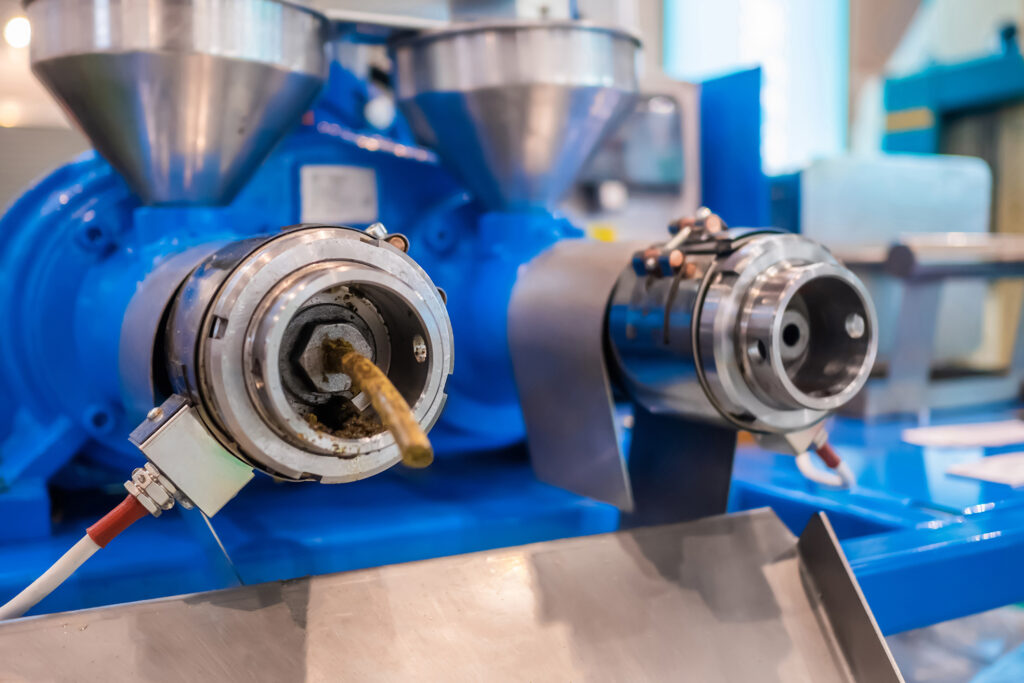
In extrusion, a solid, semi-solid or paste-like mixture enters the cylinder, is conveyed by one or more screws, subjected to compression, heating and shearing, and then forced through a die. Heat can be supplied by temperature-controlled jackets or generated internally by viscous friction and the dissipation of mechanical energy. As the mixture passes through the machine, starches and proteins undergo transformations that alter their viscosity, solubility, density, porosity and texture.
In starchy mixtures, gelatinisation and the breakdown of granules may occur, whilst in protein-based formulations, denaturation and re-aggregation of the chains may take place. The process can also inactivate enzymes and reduce the microbial load, whilst excessively harsh conditions can degrade heat-labile nutrients and cause sensory defects. Quality depends on the interaction between composition, water, temperature, mechanical energy, screw configuration, pressure, residence time and matrix.
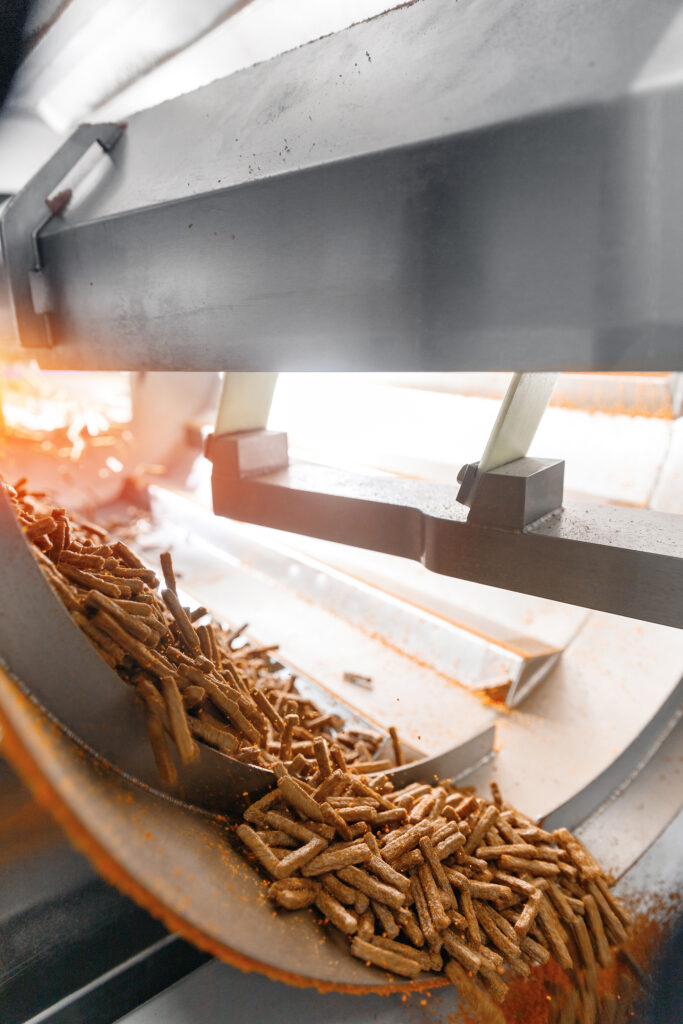
Water acts as a plasticiser; if its content decreases, torque and shear may increase, whilst high levels may limit expansion. Furthermore, the temperature set on the barrel does not necessarily correspond to that reached by the product, as this is influenced by flow rate, viscosity and mechanical energy. In directly expanded products, the sudden drop in pressure at the outlet causes part of the water to vaporise and a porous structure to form. In pellets, compact products and high-moisture meat substitutes, the aim is instead to limit expansion and stabilise a dense or oriented structure. The modern extruder must therefore be regarded as a processing machine, not merely a shaping machine.
Flexibility and innovation in plant design
Single-screw extruders remain suitable for standardised production runs and relatively stable formulations, whilst the twin-screw configuration – in particular co-rotating and interpenetrating types – offers greater flexibility, more positive conveying, more intensive mixing and a process that is less dependent on friction between the product and the barrel. This facilitates the processing of fibrous ingredients, plant by-products, high-moisture mixtures and formulations rich in protein or fat. The modular design of the components allows the functions of conveying, dispersion, kneading, compression and cutting to be differentiated along the bar.
Feeding systems are also crucial, as gravimetric feeders, side feeders and liquid injection systems must ensure precision when dealing with poorly flowing powders, ingredients with low bulk density or mixtures prone to segregation. In high-moisture processes, small variations in the water-to-solids ratio can significantly alter viscosity and structure. Technologies such as hot-melt extrusion – used to disperse and protect functional ingredients within heat-softened matrices – and reactive extrusion – which utilises the extruder as a continuous reactor to modify starches, proteins and fibres in a controlled manner – further expand the range of possible applications.
Sustainability and the circular economy
The sustainability of extrusion does not automatically stem from the continuity of the process. The benefit only becomes apparent when the integration of multiple operations reduces energy consumption, warehouse handling and processing waste. A single plant can, in fact, combine pre-cooking, mixing, heat treatment and shaping. However, to obtain a true energy balance, the production line must be assessed in its entirety, including the energy consumption for heating, cooling and any drying processes.
The most significant contribution of this technology lies in the utilisation of secondary raw materials. Minor cereals, pulses, wholemeal flours and agri-food by-products can be transformed into stable ingredients with high added value. Bran, brewers’ grains, oilseed meal and peel provide fibre, protein and bioactive compounds. Extrusion improves their hydration and functionality, transforming what was once waste into a nutritional resource.
However, integrating a by-product into an existing formulation requires careful technological assessment. Insoluble fibres and large particles risk disrupting the protein matrix, reducing expansion and increasing the hardness of the final product. Residual lipids can accelerate oxidation, whilst unwanted natural pigments and flavours limit the product’s sensory acceptability to the consumer.
To make a by-product truly usable, it is essential to characterise its moisture content, particle size and rheological behaviour. Specific pre-treatments such as drying, grinding or fermentation are often necessary. For the machine manufacturer, this presents a specific design challenge: developing feeders suitable for materials with low flow , using wear-resistant components and configuring the screws to compensate for the natural variability of the raw materials.
Plant proteins and high-moisture extrusion
One of the most interesting applications is the production of meat substitutes using high-moisture extrusion. Protein mixtures with a high water content are generally processed in a twin-screw extruder and then fed into a cooling die. In the article ‘High-Moisture Extrusion of Plant Proteins: Fundamentals of Texturisation and Applications’, published in the *Annual Review of Food Science and Technology* (2024), the authors report typical moisture contents of between 40 and 80 per cent and distinguish four zones: feeding, mixing, melting and cooling.
The proteins are hydrated, heated, compressed and sheared, losing their native conformation and developing new interactions. Heat and mechanical action must work together to generate the desired structure. Passing through the cooling die is one of the key steps because the gradual reduction in temperature stabilises the material without the rapid evaporation that would cause expansion. Gradients in temperature, velocity and viscosity promote alignment along the direction of flow and can lead to separations between protein, aqueous and polysaccharide domains.
The result is an anisotropic structure – that is, one formed of oriented fibres or layers – which splits and offers different levels of resistance depending on whether it is cut transversely or longitudinally, resulting in a fibrous texture during cutting and chewing, as would be the case with meat. Soya, wheat gluten and peas are the most established sources, but broad beans, lupins, oats, rapeseed and hemp are also being investigated.
This diversification could be one of the keys to reducing dependence on a few crops, but each source has specific properties to consider, as solubility, water-holding capacity, particle size and the content of starch, fibre and lipids all affect viscosity and textural properties. Replacing one protein with another therefore requires the process to be fine-tuned. A fibrous structure alone is not enough to guarantee acceptability. The product must retain cohesion, juiciness and integrity during cooking and consumption. A shredded product requires a distinct longitudinal separation; a burger needs a shorter, more compact structure; and a vegetable fillet must retain water and fat. Quality therefore depends on the entire sequence of extrusion, cooling, cutting, flavouring and packaging.
Variability, automation and digital control
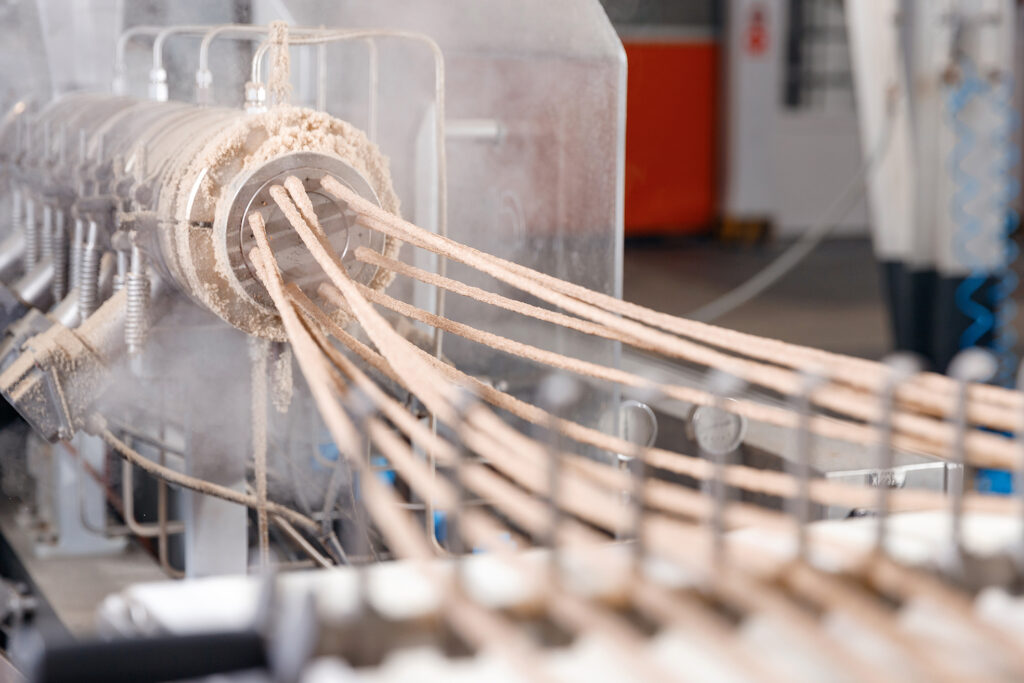
The variability of raw materials is a key challenge, as botanical origin, climatic conditions, extraction and storage can alter the functionality of flours, concentrates and isolates. Even when commercial specifications are identical, the ability to bind water and the rheological behaviour may change, affecting torque, pressure and texture. Furthermore, many processing steps take place in a closed, high-pressure environment that is difficult to observe.
For this reason, the extruder has often been described as a ‘black box’, in which the final quality can only be accurately measured at the discharge point. A batch of pea isolate with an unexpected hydration capacity can cause an abnormal rise in motor torque, forcing the operator to carry out manual interventions without full visibility. To reduce this lack of transparency, temperature and pressure sensors, torque measurement, flow rate control and spectroscopic systems can be useful. Future prospects involve increasing integration between monitoring, modelling and control, including simulation and artificial intelligence to link operating parameters and final quality.
The aim is to move beyond control based on parameters set once and for all, by introducing systems capable of predicting process variations and automatically correcting operating conditions. An advanced system could detect changes in viscosity or moisture content and adjust the water flow rate, screw speed, temperature or feed rate. Rheological modelling and process simulation can help predict how variations in formulation and operating parameters affect the behaviour of the mass within the extruder. In this way, experimental testing can be focused on the most promising conditions, reducing the need for trial and error.
The implications for manufacturers
For manufacturers, the evolution of extrusion is no longer solely about robustness and production capacity. Food companies require flexible, modular lines capable of processing a wide variety of ingredients. Interchangeable components and modular sections can reduce set-up times, whilst monitoring torque and performance can indicate wear caused by fibres, minerals and by-products.
In high-moisture lines, the cooling system must be designed as an integral part of the process, as the geometry of the channels, the uniformity of heat transfer and temperature control directly influence the fibre structure. The value of the machine will increasingly depend on its ability to adapt to variable ingredients, collect data, support scale-up and ensure repeatable results.
A platform for food design
Looking to the future of food processing, the extruder takes on the role of a key reactor for the design of structure and functionality. The introduction of fibres and new protein sources into the production line shifts the focus from simple shaping towards advanced matrix management. The synergy between gravimetric feeders, process sensors and predictive modelling now defines the boundary between a rigid production line and a flexible plant. It is precisely this adaptability that transforms the extruder into a strategic asset for the transition to the circular economy.